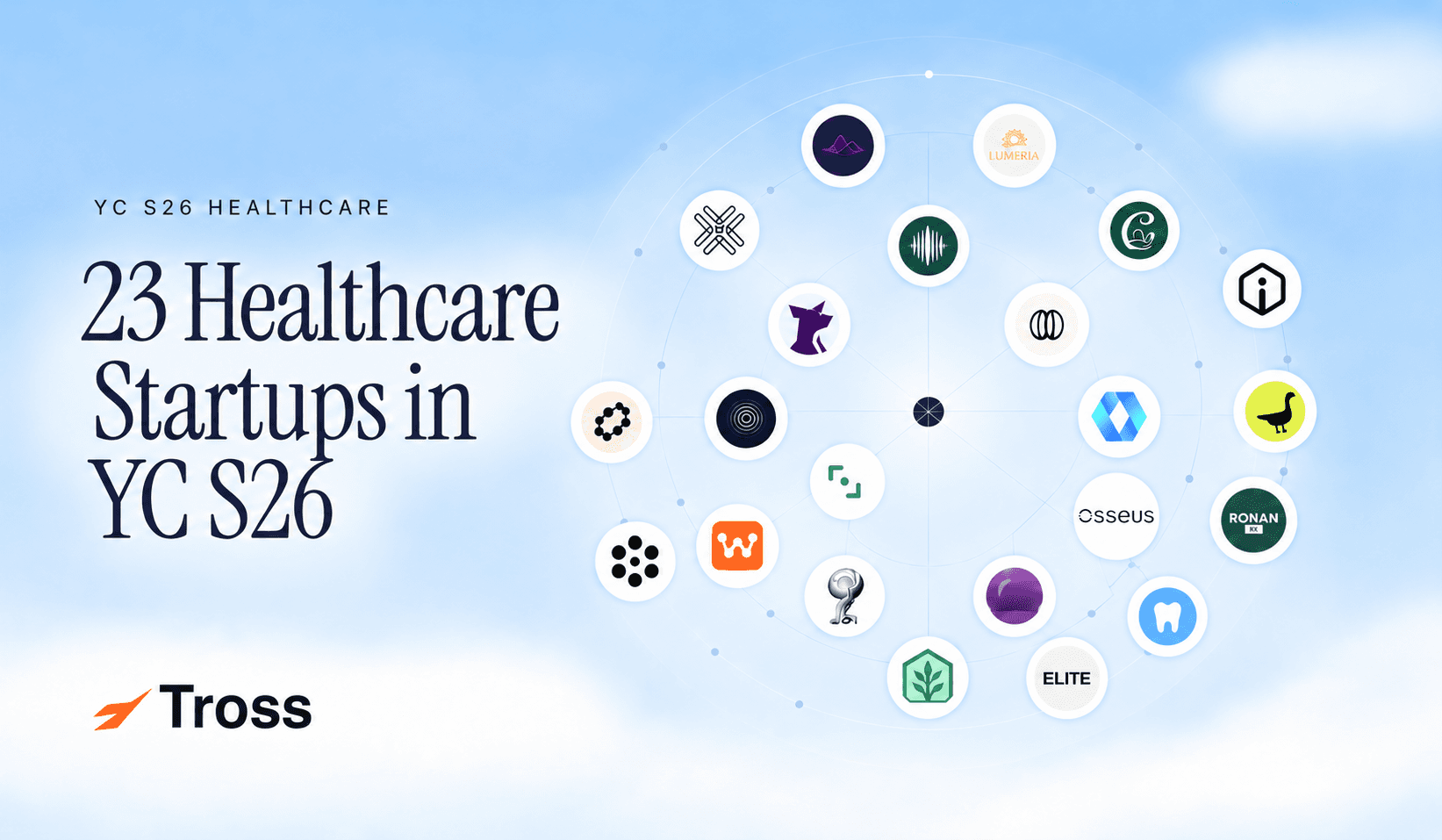
YC S26's healthcare companies span care operations, patient-data infrastructure, insurance, research and life sciences.
For products that need to exchange information with EHRs or payer portals, integration is a practical part of deployment. Tross provides APIs that help healthcare teams connect to those systems.
For teams choosing the infrastructure behind those workflows, see our comparison of API platforms for EHRs and payers.
The table below lists 23 healthcare companies from YC's S26 batch, their founders, and what they are building. Each company name links to the official website listed on its YC profile.
Healthcare startups from YC S26
Company | Founders | What they are building |
|---|---|---|
Campbell Mercer-Butcher & Max Shand | AI-powered operating system for radiology networks, automating patient scheduling and communications. | |
Prabha Dublish & Aaron Leon | Intelligence layer for patient information, pulling a patient's full medical history from every provider via one API. | |
Melvin Chen | AI agents that run primary healthcare clinic operations, from document filing to phone calls. | |
Maryam Jahed and Seak Meng Lay | AI-native, full-stack radiology practice rebuilding clinical and operational workflows with agents. | |
Paul Steven Conyngham | Personalized mRNA cancer vaccine platform, starting with dogs. | |
Maryanne Alhallak and Anthea Guo | At-home skin-tracking device and AI platform, the "Oura Ring for skin." | |
Lloyd Armbrust and Emily Colman | AI that personalizes peptides and GLP-1s (like Ozempic) to your biology using labs and wearables. | |
Jack Beecher | Dental-benefits company that sells plans directly to employers and uses AI to process claims. | |
Alfredo Gonzalez, PhD and Ranad Humeidi, PhD | A personalized research lab built around one patient, tackling complex cancer cases with AI and genomics. | |
Eta Atolia, MD, PhD | Platform that develops personalized or population-level vaccines for any cancer or infection in weeks. | |
Asaph Kupferman & Jonah Kaye | Platform that lets healthcare teams describe and deploy HIPAA-compliant internal tools connected to production data. | |
Bryan Chung & Chang Lu | AI-native decision infrastructure for health insurance, turning denied claims into source-cited, physician-attested appeals. | |
Anis Mihrshahi & Leon Mojarrabi | Personalized probiotics, sequencing your gut microbiome to predict which strains will actually colonize, guaranteed. | |
Sanjukta B. & Shaamil Karim | Foundation models trained on pre-clinical and clinical data to predict how a patient will respond to a drug in clinical trials. | |
Abraham Heifets | Extrapolative AI that discovers oral, pill-form alternatives to injectable drugs like insulin and GLP-1s. | |
Paridhi Latawa, Frank Lee & Jin Wong | 24/7 AI health and longevity companion that fuses your wearables, blood panels, and genomic data into one text-based coach. | |
Jordan Ibe & Ansh Tandon | AI-native home care agency in Michigan, running the entire back office on agents to pay caregivers more and help families get paid. | |
Rishab Jain & Aditya Jain, MD | AI-run health benefits platform for employers, steering patients toward lower-cost care trajectories to cut healthcare spend 20-50%. | |
Jacob Chia & Sid Unnithan | Voice agents that accelerate care coordination for workers' comp managed care orgs, replacing phone, fax, and email handoffs. | |
Ayush Chauhan & Daood Hashmi | An AI platform that runs any chemistry task end to end, from literature search to running the calculations itself. | |
Amie Leighton & Saroosh Khan | Full-stack, AI-native clinical group for mental health that brings independent practices into one national clinical group. | |
Raj Jagiasi & Vihaan Jagiasi | AI voice agents that run the front office for healthcare practices, handling patient calls and completing workflows inside the EHR. | |
Anish Mariathasan & Ayush Patel | Medical and biological datasets, evaluations, and reinforcement learning environments for training more capable and aligned health AI models. |
Connecting healthcare products to existing systems
For teams building around patient records or insurance workflows, access to EHR and payer data is part of getting the product into use. Tross provides APIs for EHRs and payer portals, helping healthcare teams connect their products to the systems their customers already use.
Frequently asked questions
Why do EHR and payer connections matter for healthcare products?
Products that support clinical or insurance workflows often need to exchange information with the systems providers and health plans already use. The specific data, permissions and workflows needed depend on the product and its customers.
Are FHIR APIs sufficient for every healthcare workflow?
Not always. FHIR standardizes how specific health-data resources can be exchanged, but teams still need to confirm the data available, authorization model and whether each required workflow is supported by the systems they connect to.
Get APIs for any EHR or Payer Portal
Bridge the gap to EHR and Payer data with enterprise-grade APIs designed for scale
Book a demo
Get APIs for any
EHR or Payer Portals
Tross
© 2026 Tross. All rights reserved.