← Back to blog
5 Best API Platforms for Health Tech Startups to Integrate With EHRs and Payers in 2026
Your app can talk to one EHR. Then a customer asks it to check a claim in a payer portal too. That means more logins, more rules and more data formats, and the work adds up fast. Here are 5 APIs for reading EHR and payer data, and who each one fits.
Key Takeaways
EHRs and payer portals together: Tross reads and writes back into multiple EHRs and fetches claim status from payer portals.
Many EHR connections: Redox reports 100+ EHR connections and supports writeback.
Outside clinical records: Particle Health and Health Gorilla pull records from national networks.
Payer transactions: Stedi covers eligibility, claim status and claims submission, and reports 3,500+ payers.
At a Glance
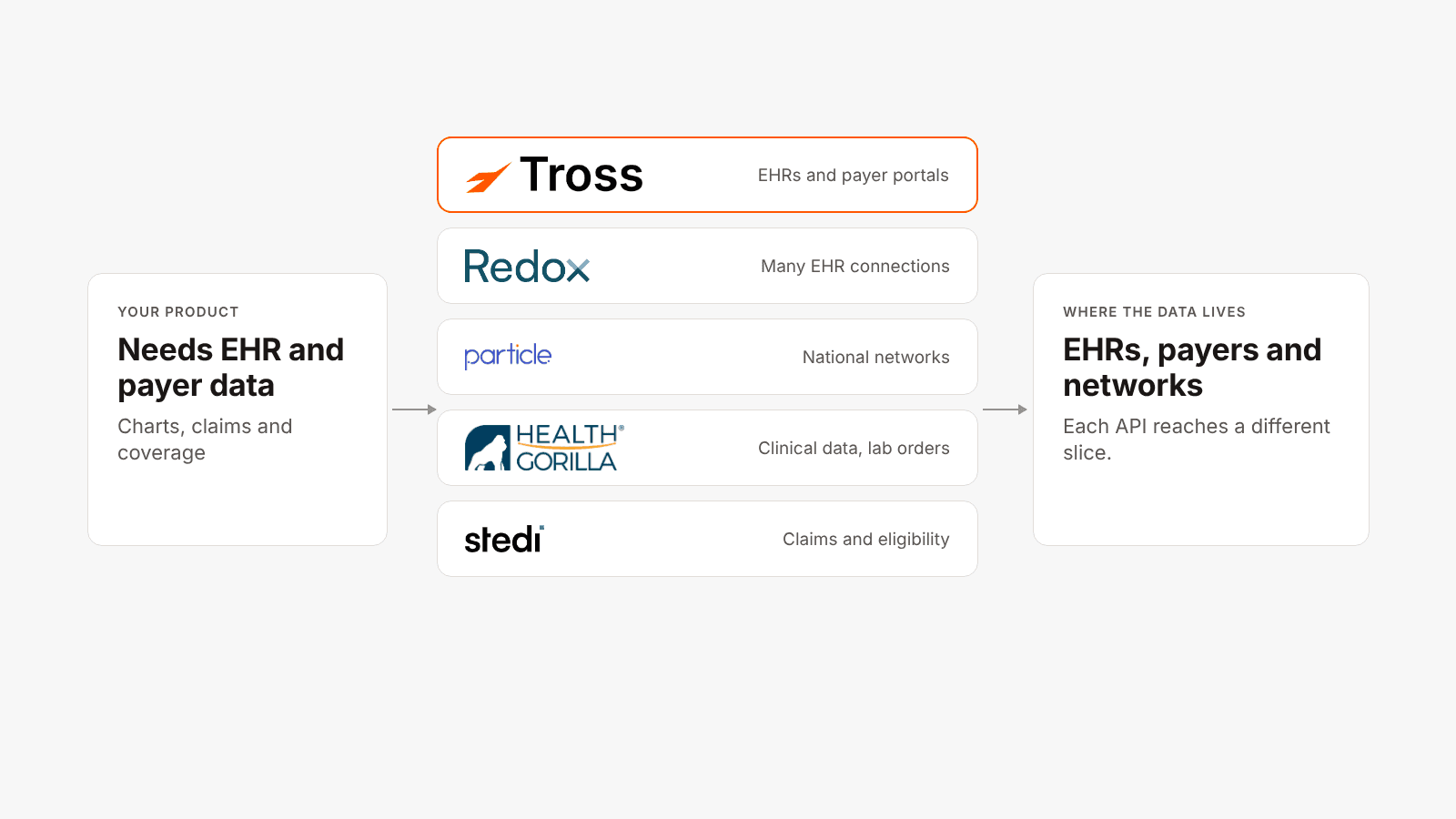
Tool | EHR Reads | EHR Writes | Payer Data | Best For |
|---|---|---|---|---|
Tross | Yes, patient data retrieval | Yes, multiple APIs | Claim status from payer portals | EHRs and payer portals in one place |
Redox | Yes | Yes, EHR-optimized writeback | Supports X12 messages | Standardizing many EHR connections |
Particle Health | Yes, from national networks | Not listed | Not listed | A patient's outside records |
Health Gorilla | Yes, clinical data | Lab orders | Not listed | Clinical data and lab ordering |
Stedi | Not listed | Not listed | Eligibility, claim status, claims and ERAs | Payer transactions through an API |
1. Tross: EHRs and Payer Portals in One API
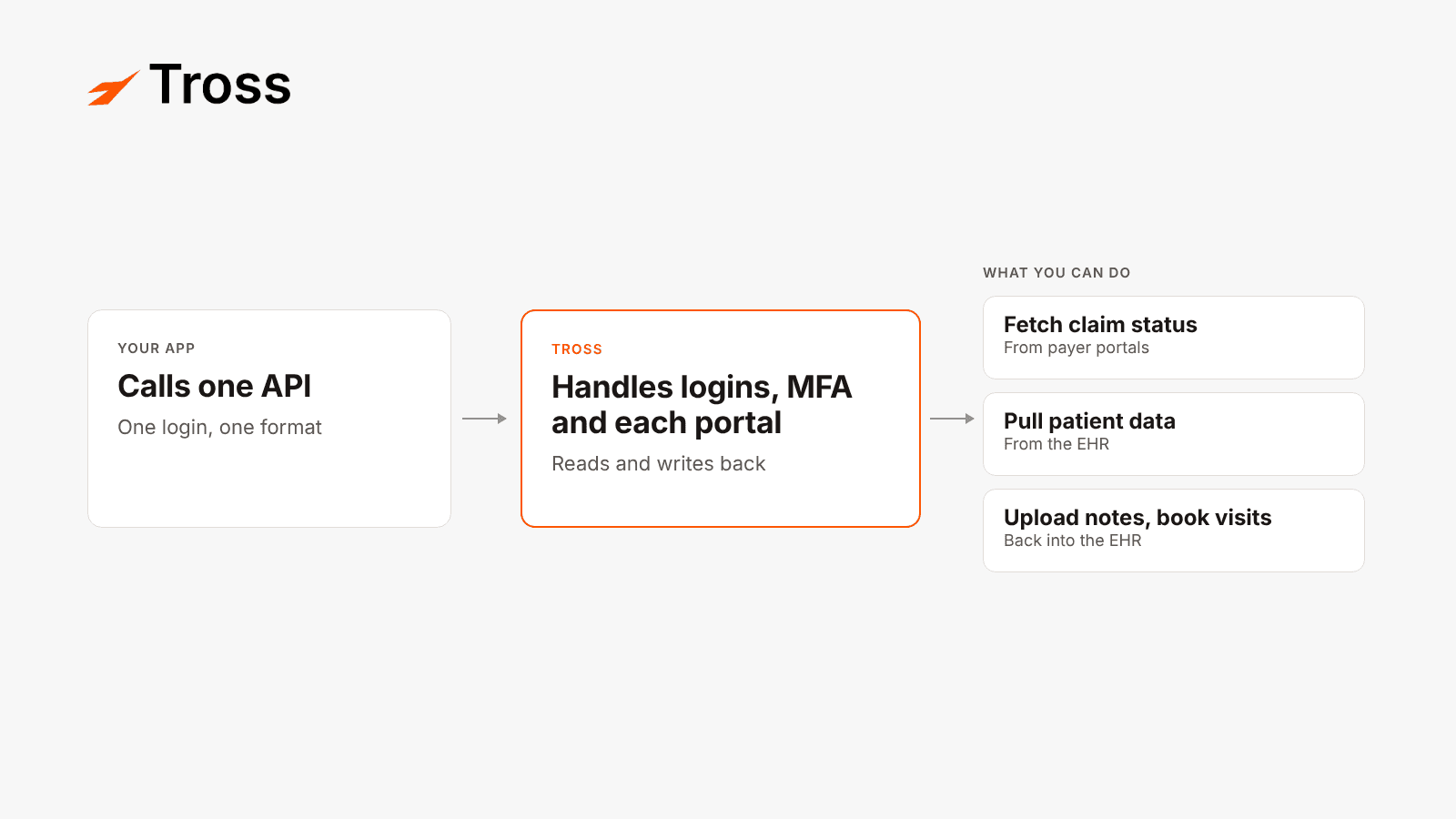
Most claim workflows touch two systems: the payer portal and the EHR. Tross covers both through APIs. Fetch claim status from a payer portal such as Availity or UnitedHealthcare, then pull patient data, upload notes or schedule appointments in the EHR. Supported EHRs include athenahealth, eClinicalWorks, ModMed, Netsmart and TherapyNotes, plus EyeMed, EZDerm, Glace and Pear, with more being added.
Supported platforms go live right away, and a new platform typically takes about a week. Tross handles MFA and OTP for you, acts as a data transport layer, encrypts data at rest and lets you set the data retention policy. It is HIPAA compliant and SOC 2 Type 1 certified, and is built for latency-sensitive uses such as voice agents.
2. Redox: Standard API Across Many EHRs
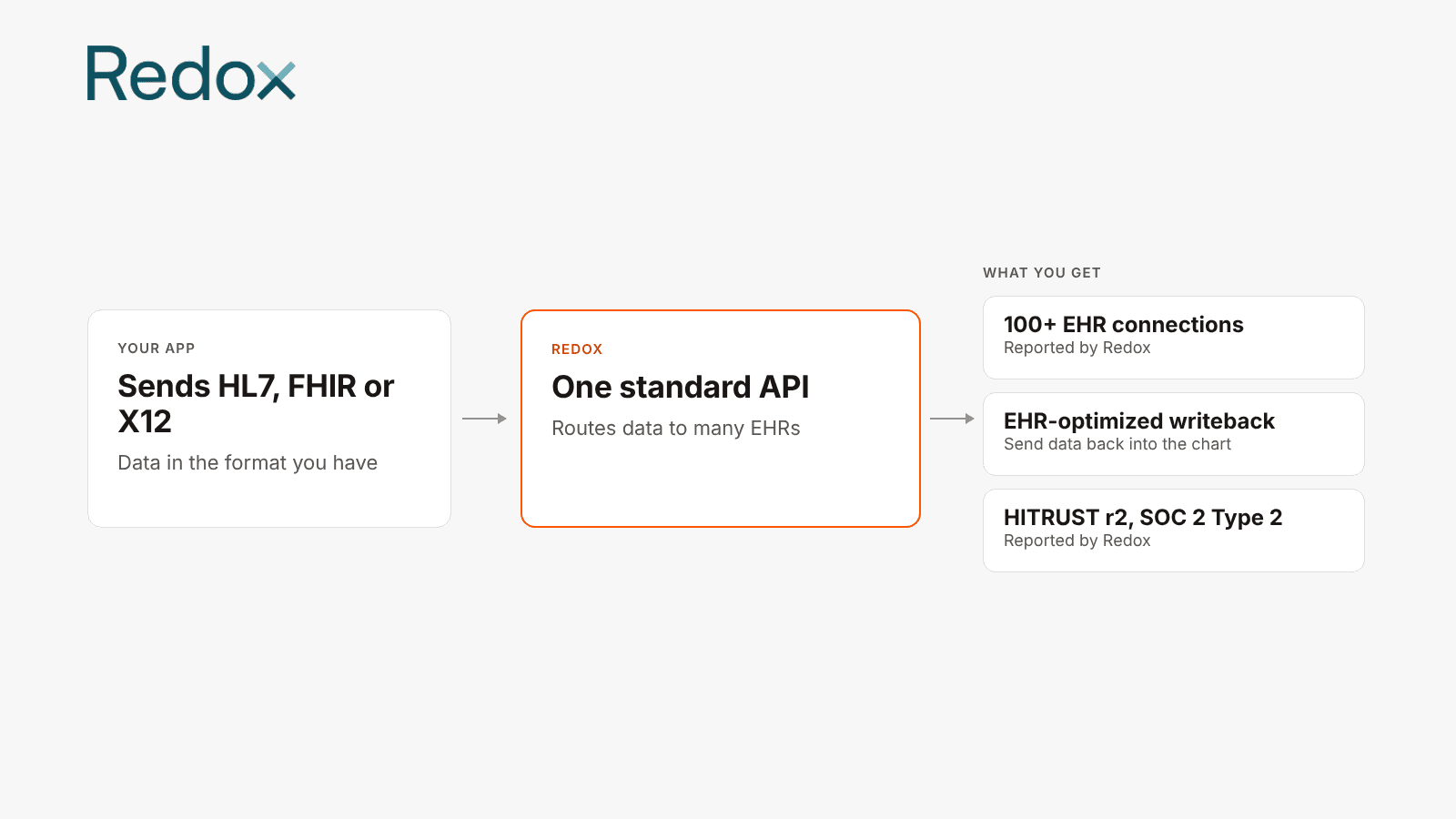
Redox is built for reach. It reports 100+ EHR connections and 14,900+ live integrations, and it offers EHR-optimized writeback. It accepts HL7 v2, FHIR, X12 and CDA, so payer messages can flow through as X12. It reports HITRUST r2 certification and a SOC 2 Type 2 report. It suits teams selling into health systems on many different EHRs.
5 Best Redox Alternatives to Integrate with EHRs in 2026
3. Particle Health: Records From National Networks
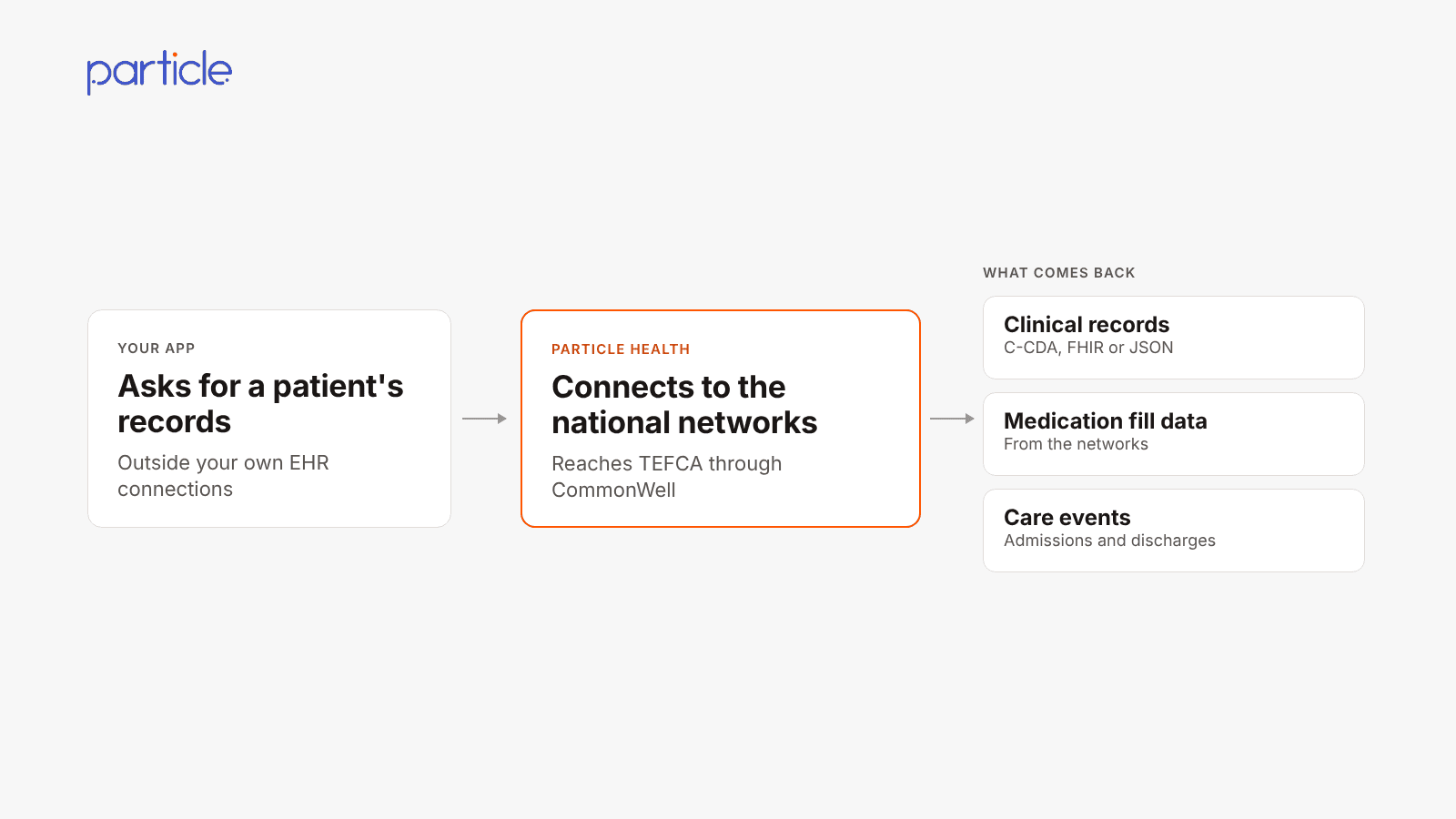
Particle connects to all three nationwide health information networks and reaches TEFCA through CommonWell, its QHIN. It returns clinical records, medication fill data and admission and discharge events as C-CDA, FHIR or JSON.
4. Health Gorilla: Clinical Data and Lab Orders
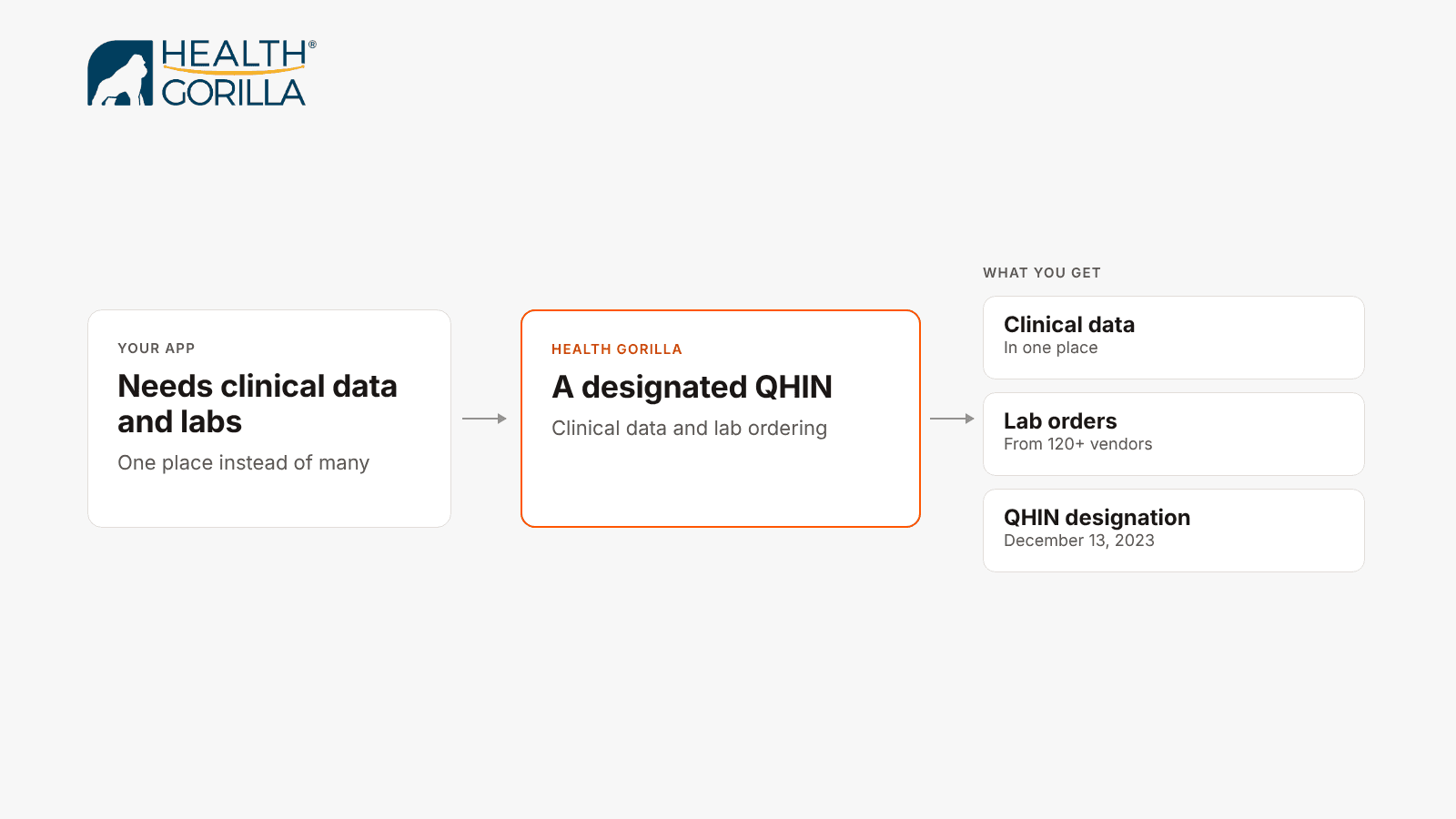
Health Gorilla was designated a Qualified Health Information Network (QHIN) on December 13, 2023. It offers clinical data in one place and lets you order labs from 120+ vendors electronically.
5. Stedi: Payer Transactions Through an API
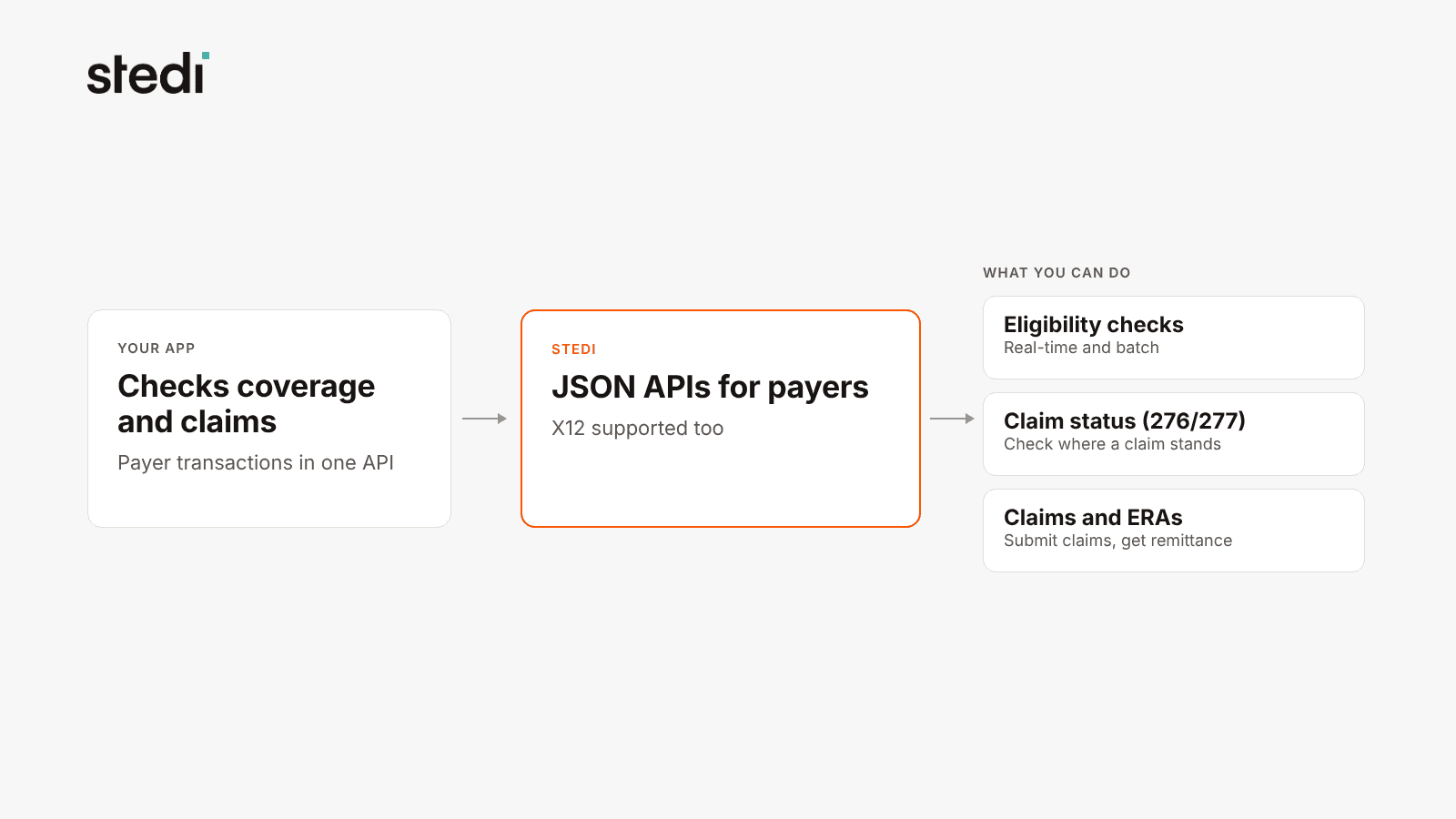
Stedi offers JSON APIs for payer transactions, with X12 support as well. It covers real-time and batch eligibility checks, claim status (276/277), claims submission (professional, dental and institutional) and electronic remittance advice (ERAs). Stedi says it covers 3,500+ U.S. payers, reports HIPAA, HITRUST and SOC 2 compliance. Its pages focus on payer transactions, not EHR reads and writes, so pair it with an EHR tool if you need both.
How to Choose
If your workflow touches both an EHR and a payer portal, start with Tross. It is the one option here that reads and writes in EHRs and also fetches claim status from payer portals. Pick Redox if you are standardizing many health system connections. Pick Particle or Health Gorilla if you mainly need a patient's outside records. Pick Stedi if your product is built around payer transactions such as eligibility and claims.
5 Best Tools for eClinicalWorks Write Access Without Its Partner Program in 2026
Which EHRs Should a Behavioral Health AI Startup Integrate With in 2026?
Frequently Asked Questions
Q1. How does a health tech startup get data out of an EHR?
Through an API that the EHR or an integration platform provides. It lets your software read patient records, notes and appointments, and in some cases write data back. Each EHR has its own APIs and approval steps.
Q2. How does a health tech startup get payer data like eligibility and claim status?
Through a payer API or a payer portal. Stedi, for example, covers eligibility checks, claim status, claims submission and electronic remittance advice (ERAs) through APIs. Tross fetches claim status from payer portals.
Q3. Can one platform handle both EHR and payer workflows?
Only some can. Tross reads and writes in EHRs and fetches claim status from payer portals. Redox connects to many EHRs and accepts X12 payer messages. Stedi covers payer transactions only, so pair it with an EHR tool if you need both.
Q4. What does an EHR integration platform do?
It connects your software to EHRs so you do not build each connection yourself. Some, like Tross, handle logins and each EHR's quirks for you. Others, like Redox, give you one standard API over many EHR connections.
Q5. Should I use an EHR's own API or an integration platform?
If you only need one EHR, its own API can work, but you handle its approval steps and upkeep yourself. If you need several EHRs, a platform saves the repeat work, because each EHR has its own APIs and approvals. Platforms differ in which EHRs they cover and whether they support writing data back, so compare those first.
Q6. What compliance should I check before choosing a vendor?
Start with a Business Associate Agreement. HIPAA requires one with any vendor that handles patient data for you, and it must require the vendor to protect that data under the HIPAA Security Rule. Then ask for proof of its security controls, such as a SOC 2 report or HITRUST certification, and how long it keeps your data.
Q7. How long does it take to go live?
It depends on the vendor and the EHRs you need. With Tross, supported platforms go live right away and a new platform typically takes about a week.
Sources
Tross FAQs - ontross.com (2026)
Redox - redoxengine.com (2026)
Redox for EHRs - redoxengine.com (2026)
Introduction to Particle Health - docs.particlehealth.com (2026)
What Health Gorilla's QHIN designation means - healthgorilla.com (2026)
Stedi Healthcare - stedi.com (2026)
Get APIs for any EHR or Payer Portal
Bridge the gap to EHR and Payer data with enterprise-grade APIs designed for scale
Book a demo
Get APIs for any
EHR or Payer Portals
Tross
© 2026 Tross. All rights reserved.