← Back to blog
What Does the Abridge - Altrina Deal Mean for Healthcare AI?
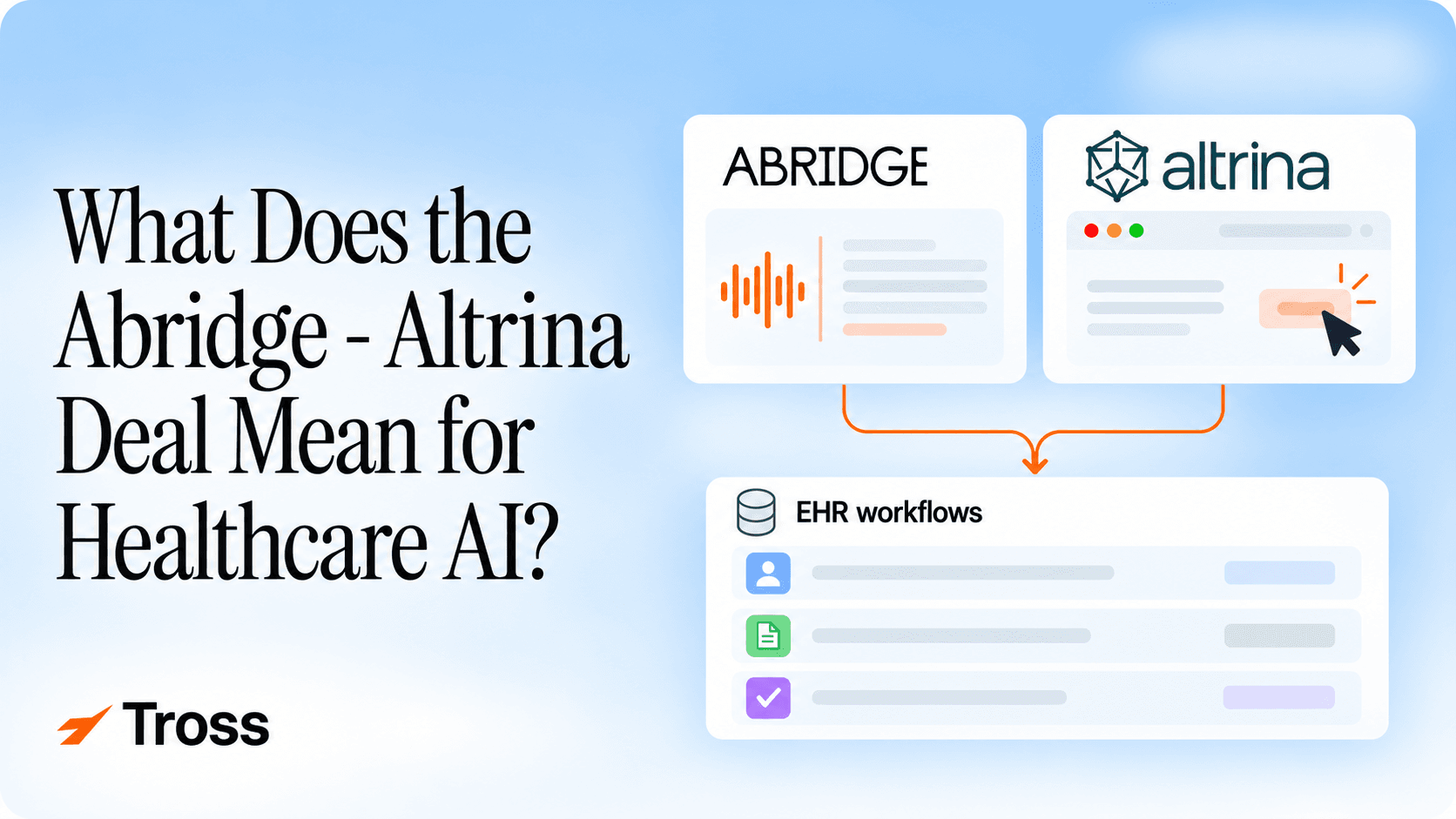
EHR automation is becoming a core part of healthcare AI. Abridge's July 2026 deal with Altrina is a useful signal: strong models are not enough if an AI product cannot complete work inside the software clinicians already use. Abridge said the Altrina team brought expertise in browser-based AI agents, healthcare workflow automation, and automating workflows across electronic health record systems.
That is the integration problem Tross addresses: healthcare AI teams often need to read from, write to, and complete workflows across many EHRs and payer portals, not just generate an answer outside the system of record.
Key takeaways
Abridge is moving beyond note generation. Its public product work already includes deeply integrated Epic documentation workflows and clinician-reviewed orders.
Altrina adds workflow execution expertise. Abridge specifically highlighted browser and computer-use agents, EHR workflow automation, and production reliability.
The deal points to an execution layer for healthcare AI. The value is not only generating the right output, but getting that output into the software and workflow where work actually happens.
Abridge's expansion into EHR workflow automation
Abridge brought in a team that had been building browser and computer-use agents and applying them to healthcare workflows. In its July 20 announcement, Abridge said Altrina co-founders Mo Nasir and Harvey Hu and founding engineer Karthik Prasad were joining the company. It specifically called out their work on browser-based AI agents, EHR workflow automation, and resilient production infrastructure.
Altrina's own site says the team built browser and computer-use agents and automated workflows across electronic health record systems. Its Y Combinator W25 profile describes an automation platform that could turn demonstrated browser workflows into repeatable automations.
The important signal is not that browser agents replace APIs. It is that healthcare AI products increasingly need an execution layer as well as a model layer.
Why EHR automation matters for healthcare AI
An AI model can summarize a visit, predict a next action, or draft an order. The product becomes more useful when that output can move into the right EHR workflow with the right patient and encounter context.
Abridge has been heading in that direction for years. Its 2024 Abridge Inside announcement described recording in Epic Haiku and reviewing AI-generated notes in Epic Hyperspace. In 2025, Abridge announced inpatient workflows and outpatient orders that could be queued for clinician review.
Altrina's background fits that trajectory. It brings experience with agents that do more than produce text. They navigate software and complete multi-step actions.
Why the execution layer matters
Integration gets data in and out of the EHR. The execution layer turns that access into completed work. A healthcare AI product may generate the right note, order, or next action, but still fall short if it cannot place that output into the workflow clinicians actually use.
Official APIs are useful when they expose the action a product needs. But some workflows still live in the EHR interface or span several screens and systems. That is where browser and computer-use automation becomes relevant, and why Altrina's work fits Abridge's direction.
Why browser automation matters inside EHRs
Altrina's relevance is that it worked on agents that can navigate software and carry out multi-step workflows, not just generate text. In healthcare, that matters when an AI product needs to do something inside an EHR after producing an answer.
Browser automation does not need to replace official integrations. It can extend the execution layer to workflows that are available through the user interface but not exposed through a practical API path.
What this means for healthcare AI teams
Start with the action your product must complete. Reading data, writing a note, creating an order, checking claim status, and completing a multi-screen workflow can require different integration paths.
Use the best execution path for each workflow. Official APIs are useful where they cover the action. Browser or computer-use agents can matter when the workflow only exists in the software interface.
Treat reliability as part of the product. Authentication, permissions, exceptions, UI changes, auditability, and human review all matter when AI moves from generating output to taking action.
The bigger signal from Abridge and Altrina
Abridge had already shown the value of putting AI inside clinical workflows. Bringing in the Altrina team adds experience in agents that can operate software, not just generate text.
The broader signal for healthcare AI is that model quality is only part of the product. The execution layer determines whether AI can reliably do useful work inside healthcare software.
Next steps for healthcare AI teams
If your product needs to read or write across EHRs and payer portals, Tross provides APIs for supported workflows such as EHR note upload, appointment scheduling, payer claim status and other system actions, so your team does not have to build every connection from scratch.
For practical integration options, compare eClinicalWorks write-access tools and Redox alternatives for EHR integration.
Frequently asked questions
What did Altrina build?
Altrina built browser and computer-use agents for automating workflows across software, including EHR systems. Its Y Combinator profile described a platform that could turn demonstrated browser workflows into repeatable automations.
What did Abridge say the Altrina team brings?
Abridge highlighted the team's work on browser-based AI agents, EHR workflow automation, and resilient production infrastructure when it announced that Altrina's co-founders and founding engineer were joining Abridge.
Why does browser automation matter for healthcare AI?
Browser automation matters when an AI product needs to complete a workflow inside healthcare software rather than only generate text. It can be useful for actions that are available in the user interface but do not have a practical API path.
How was Abridge already working inside EHR workflows?
Abridge's earlier product announcements described recording in Epic Haiku, reviewing generated notes in Epic Hyperspace, and queuing inpatient and outpatient orders for clinician review.
Did Abridge acquire Altrina?
Abridge announced on July 20, 2026 that Altrina's co-founders and founding engineer were joining Abridge. Industry reporting, including TechTarget, described the transaction as an acquisition. Altrina's site now says the team has joined Abridge and that the standalone Altrina platform is no longer available.
Sources
Abridge Welcomes the Altrina Team - Abridge, July 20, 2026
Altrina has joined Abridge - Altrina
Altrina: The SOP Automation Platform - Y Combinator
Abridge Announces Abridge Inside with Epic Integration - Abridge, February 13, 2024
Abridge Inside for Inpatient and Outpatient Orders - Abridge, June 18, 2025
Abridge buys agentic AI, workflow automation company - TechTarget, July 28, 2026
Get APIs for any EHR or Payer Portal
Bridge the gap to EHR and Payer data with enterprise-grade APIs designed for scale
Book a demo
Get APIs for any
EHR or Payer Portals
Tross
© 2026 Tross. All rights reserved.